
For many life sciences organizations, a Veeva Vault go-live marks a milestone moment. Months of workshops, validation cycles, migration effort, and user training finally converge. Teams celebrate. Leadership feels confident. Users explore with optimism.
And then…the cracks slowly appear.
Performance frustrations. Process inefficiencies. Endless enhancement requests. Frustrated users. Concerns that “Vault isn’t delivering the value we expected.”
In most cases, Vault doesn’t fail technically. It fails operationally.
At Wolvio, we see a consistent truth across organizations globally: Vault failures are rarely about the platform. They are about how Vault is designed, governed, and operated after go-live.
Go-Live Is Treated as the Finish Line — But It Is Actually the Starting Point
Most programs are structured like projects:
- Gather requirements
- Configure Vault
- Validate
- Migrate
- Train
- Go live
And then:
- Vendors roll off
- Project budgets close
- Ownership becomes unclear
- Energy disappears
But Vault is not a deliverable. Vault is a living operating platform.
Organizations often underestimate:
- Continuous enhancement needs
- Behavior and adoption maturity
- Operational governance requirements
- Performance and usage evolution
- Release alignment workload
Vault failures don’t happen day one. They happen 6 to 18 months after go-live when the system stops evolving.
Governance Models Are Weak or Non-Existent
One of the most common root causes we see:
Vault is implemented, but it is not owned. Teams assume that assigning an Admin equals governance. It doesn’t.
Without governance:
- Configuration changes become uncontrolled
- Metadata behaviors become inconsistent
- Enhancement backlogs become political battles
- Domain alignment breaks
- Processes drift away from design intent
- Vault becomes fragile.
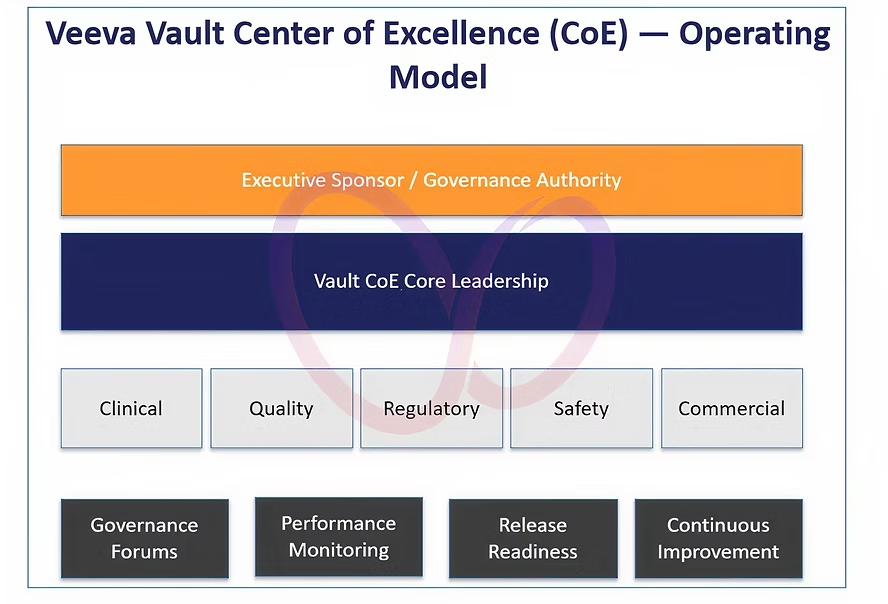
Strong Vault Center of Excellence (CoE)
A Vault CoE is not a concept. It is the engine that keeps Vault valuable, governed, scalable, and continuously improving.
A Vault CoE:
- Owns Vault strategy
- Safeguards design integrity, performance, and architecture
- Governs change
- Aligns IT + Business + Compliance
- Drives performance and usability
- Ensures release readiness
- Enables ongoing improvement
- Creates Clear ownership and accountability
- Establishes sustainable governance
- Strengthen Adoption and user confidence
Implementations Focus on Features — Not Value
Many programs deliver Vault functionality successfully. But businesses often don’t feel transformation.
Why? Because implementations focus on:
- Requirements fulfillment
- Configuration completion
- Validation success
Instead of:
- Productivity
- Usability
- Process outcomes
- Operational efficiency
Vault becomes a digital version of the old process, not a better one.
Object Model & Workflow Design Hurt Performance
Performance problems are rarely platform issues. They are design issues.
Over-complex object models cause:
- Slow experiences
- Difficult reporting
- Metadata overload
Bad workflow design causes:
- Slowness
- Stalls
- Automation failures
Vault is a platform. It must be engineered, not just configured.
“Don’t Touch It After Go-Live” Kills Value
Some organizations freeze Vault post go-live due to various reasons. This mindset destroys value
Vault must:
- Evolve
- Mature
- Automate deeper
- Simplify continuously
Stagnant Vaults become irrelevant Vaults.
Release Readiness Is Ignored
Veeva releases:
- Better UX
- Performance upgrades
- Functional enhancements
Many organizations:
- Ignore them
- Delay indefinitely
- Miss value
This is lost opportunity.
Adoption Is Assumed
Training ≠ Adoption.
Without:
- Continuous enablement
- Role-aligned learning
- Reinforcement
- Listening to users
Adoption suffers.
Shadow processes return.
Vault Becomes an IT Tool — Instead of a Business Platform
This is one of the biggest silent failures.
Vault must be:
- Business-owned
- Strategically aligned
- Operationally governed
If IT runs Vault alone, it becomes technology instead of transformation.
So Why Do Vault Programs Really Fail?
Because many organizations underestimate what Vault truly is:
Vault is:
- A digital operations platform
- A compliance backbone
- A strategic enablement system
- A continuously evolving capability
It needs:
- Ownership
- Governance
- Engineering discipline
- Business leadership
And the Center of Excellence is what makes that real.
What Successful Organizations Do Differently
They:
- Build a Vault CoE
- Treat Vault as a strategic platform
- Engineer performance
- Govern responsibly
- Adopt releases proactively
- Focus on business value
- Invest in people and adoption
They don’t ask: “Did we implement Vault successfully?” They ask: Is Vault
continuously making our business stronger, faster, and smarter?
That’s the real success metric.
- Vault Quality 25R3 Smarter QMS Workflows - July 2, 2026
- Sustaining Momentum in Vault Programs After Go-Live – Advanced Edition - May 26, 2026
- Optimizing PromoMats Review Cycles - May 6, 2026