
How 900 Million People Use Artificial Intelligence Every Day—And Most
Don’t Even Know It
Analysis | December 2025
Here’s a peculiar fact about the future: it sneaks up on you while you’re busy
checking the weather.
Right now, as you read this, approximately 900 million people worldwide are actively using artificial intelligence tools. That’s roughly 11% of humanity. But here’s the twist that makes this statistic genuinely interesting: according to a Gallup survey from 2025, 99% of Americans used at least one AI enabled product in the past week-yet only about half believed they were “using AI” at all.
The gap between perception and reality tells us something important about where we actually are in this
technological moment. It’s not 2035. The robots haven’t taken over. But something arguably more
interesting is happening: AI has become so embedded in the mundane infrastructure of daily life that
most people interact with it the way they interact with electricity—constantly, invisibly, and without a
second thought.

We didn’t notice the revolution because it came disguised as convenience.
The Invisible AI Economy
Let’s start with what you probably did this morning. If you checked the weather, you used AI—those forecasting models are now almost entirely machine learning driven. If you opened Netflix,
Spotify, or YouTube, algorithms decided what you’d see before you made a single conscious choice.
If you drove anywhere using Google Maps or Waze, AI predicted traffic patterns and routed you
accordingly. Your email’s spam filter? AI. That surprisingly relevant ad for hiking boots? Also AI,
though perhaps creepily so.
The Gallup data breaks this down with uncomfortable precision: weather forecasting apps (87%),
streaming services (83%), online shopping (82%), social media (81%), navigation (81%), and virtual
assistants (50%). Here’s the kicker: of those who initially claimed they hadn’t used any AI-enabled products in the past week, 87% had actually used at least three. We’re living in an AI-saturated
environment while maintaining the pleasant illusion that we’re not.
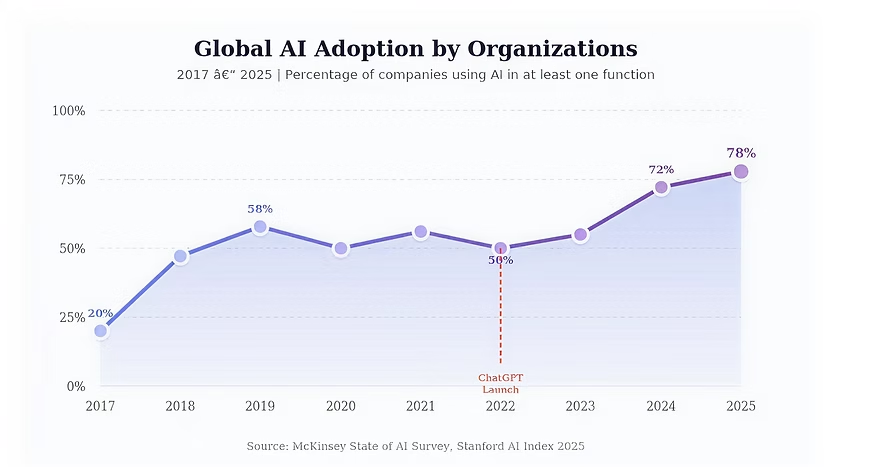
The trajectory is clear: AI went from experimental (20% in 2017) to essential (78% in 2025)
The Chatbot Wars: A Market in Flux
Then there’s the AI that people actually know they’re using – the chatbots, the generative tools, the
things that feel futuristic even when they’re helping you draft a birthday message to your aunt.
ChatGPT remains the undisputed heavyweight champion, commanding 60 – 83% of market share
depending on how you measure it. But the story beneath that dominance is more nuanced than the
headlines suggest.
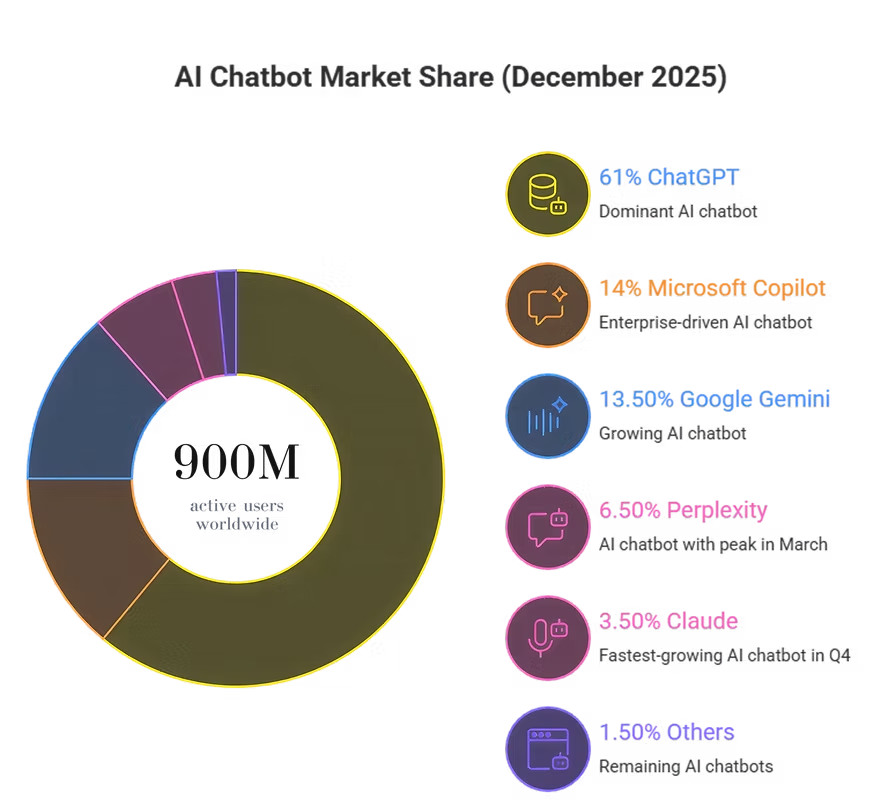
ChatGPT dominates, but growth is slowing as Gemini and Claude gain ground
The Perplexity story is particularly instructive. A year ago, the startup was valued at $18 billion,
advertising on local radio stations from San Francisco to small towns in India. Their pitch was elegant:
search, but with citations and no clutter. It worked – until the underlying models caught up. When
Claude and Gemini integrated search natively with superior reasoning, the “prettier wrapper” value
proposition cracked. They’re now fighting for relevance while paying API costs to providers who are also their competitors.
What People Actually Do With AI
Here’s where the data gets genuinely surprising. If you asked most people what AI chatbots are “for,”
they’d probably say coding, or maybe writing professional documents. The actual usage patterns tell a
different story.

The tech industry built tools for productivity. People use them for existential navigation.
Notice what’s at the top. Not “write my quarterly report” or “debug this Python script.” Therapy. Life
organization. Finding meaning. This shouldn’t be surprising if you’ve been paying attention. Mental
health resources are chronically underfunded everywhere. The “loneliness epidemic” is real and
measurable. And here’s a service that’s available 24/7, doesn’t judge, doesn’t get tired, and never tells
you to “just think positive.”
The Great Job Panic (And What the Data Actually Shows)
Now for the question everyone’s actually asking: is AI coming for your job?
The honest answer is: it’s complicated, and the evidence is more nuanced than either the doomsayers or the optimists want to admit.
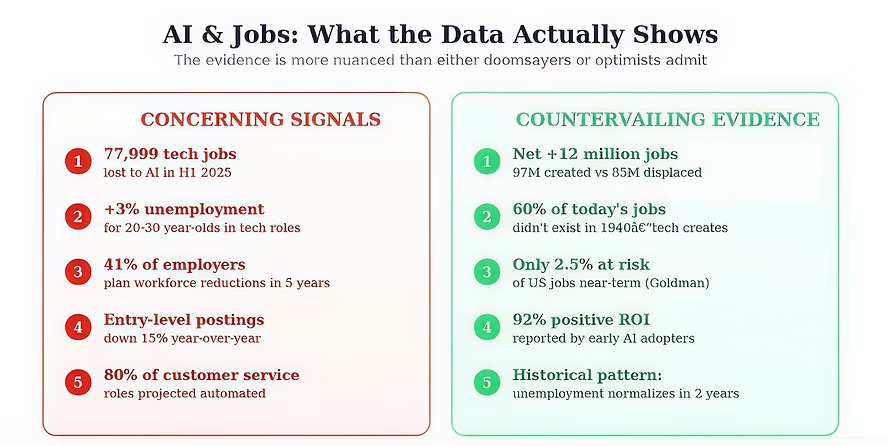
The evidence cuts both ways – reality is messier than the headlines
The Federal Reserve Bank of St. Louis found something genuinely interesting: there’s a correlation
between AI exposure and rising unemployment, but it’s subtle – about 0.2-0.3 percentage points.
And here’s the weird part: the least AI exposed workers actually saw larger unemployment
increases than the most exposed ones.
One theory: companies are reassigning tasks, not eliminating workers. If AI handles 30% of a
knowledge worker’s tasks, the firm might reassign the less-skilled support staff rather than the
AI-exposed worker themselves. The disruption is real, but it’s not falling where you’d expect..
The question isn’t ‘will AI replace your job?’ It’s ‘will someone using AI replace you?
The Three Layers of AI
Perhaps the clearest way to understand where we are is to recognize that AI now operates on three
distinct layers – each with different visibility, different users, and different implications.
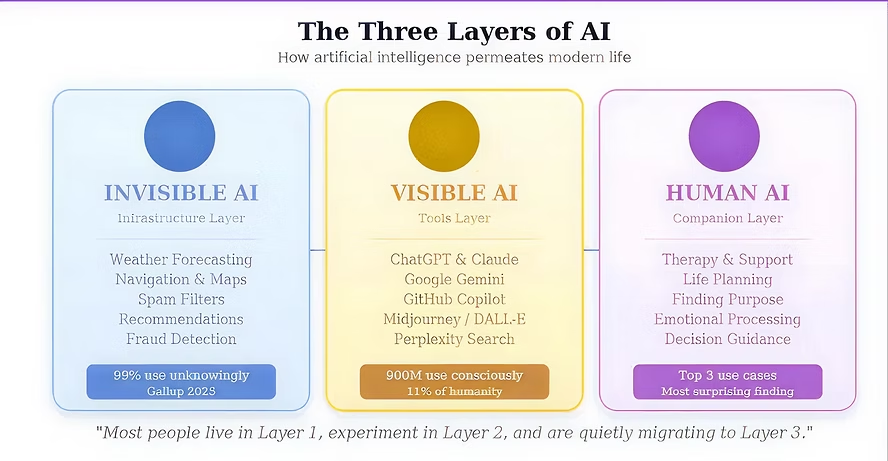
The conversation about AI tends to focus on the middle layer-the chatbots, the visible tools.
But the real story spans all three.The invisible layer is already universal. The visible layer is growing
fast but shallow. And the human layer-people using AI for emotional support and existential guidance-is the most surprising and perhaps most consequential development of all.
The Adoption Paradox
Here’s the paradox at the heart of the current AI moment: adoption is both massive and shallow.

Massive scale, shallow depth – this is what early adoption actually looks like
This isn’t failure – it’s what early adoption actually looks like. We’re in what Menlo Ventures calls the
transition from the “access phase” to the “depth phase.” The winners won’t be those who adopted first.
They’ll be those who figure out how to move from occasional use to systematic integration.
Where This Leaves Us
Three years after ChatGPT’s launch, we have enough data to say something definitive: the
AI revolution is real, but it’s not what either its biggest boosters or its harshest critics expected.
It didn’t arrive with the drama of science fiction. It arrived with the quiet convenience of your
weather app getting slightly more accurate, your spam filter getting slightly smarter, and your streaming
service knowing slightly too well what you want to watch at 11 PM on a Wednesday
The job apocalypse hasn’t materialized—yet. But neither has the productivity miracle. What we have
instead is something messier and more interesting: a technology that’s everywhere and nowhere,
adopted by billions but mastered by few, transforming some jobs while leaving others untouched, and
being used for purposes its creators never intended.
The question isn’t “will you use AI?” You almost certainly already do.
The question is whether you’ll use it consciously—or let it use you
The next decade won’t belong to those who fear AI- or worship it but to those who learn to work with it deliberately.
Data compiled from: Gallup, Stanford AI Index 2025, McKinsey State of AI 2025, OpenAI/NBER Research,
Menlo Ventures Consumer AI Survey, Goldman Sachs Economic Research, Federal Reserve Bank of St.
Louis, Sensor Tower, Cloudflare, First Page Sage, Harvard Business Review, World Economic Forum
Future of Jobs Report 2025.
- The End of Screens: AI and the Future of UI - April 21, 2026
- Veeva Vault 26R1 Doctype Triggers Guide - April 7, 2026
- Enterprise AI Adoption Roadmap Guide - March 5, 2026