
For decades, we’ve adapted to machines.
We click buttons, navigate menus, fill forms and repeat the same steps every day.
We call it user experience.
But much of it is simply trained behavior.
Because user interfaces were never the destination.
They were a workaround.
Buttons, screens, and menus existed because machines couldn’t understand intent. So interfaces became translators between humans and systems.
But AI changes that.
For the first time, machines are learning to understand us through language, context and intent.
And that changes the role of UI entirely.
From UI to Intent
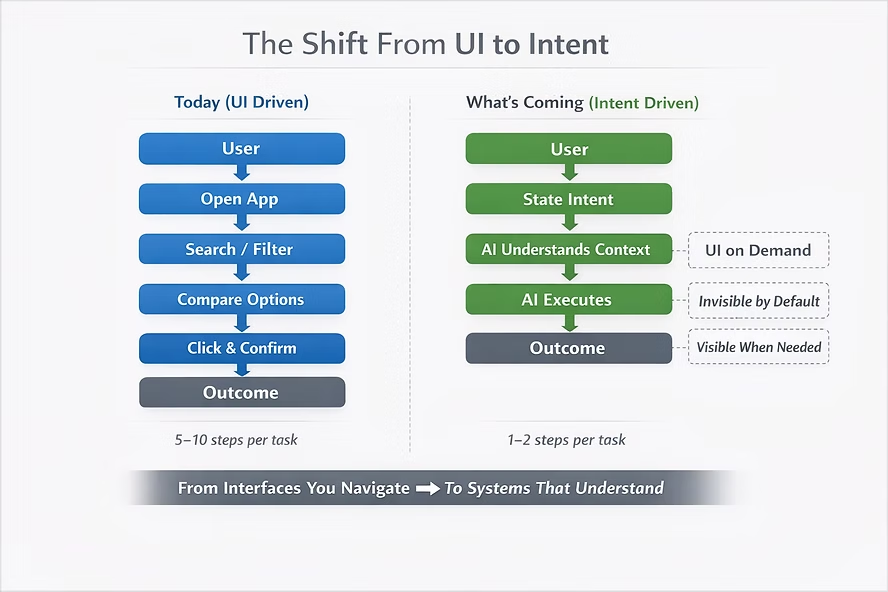
Traditionally, users tell systems how to do something.
Open an app
Apply filters
Compare options
Make a selection
But increasingly, users can simply tell systems what they want.
“Find me the best option under ₹10,000 for this weekend.”
And the system does the rest.
That isn’t better UI.
That is less UI.
The Rise of UI on Demand
Interfaces won’t disappear completely.
But they may stop being the default.
Instead, they appear only when necessary.
Routine tasks → AI handles them
Complex decisions → UI appears
High-risk actions → humans stay in control
Invisible by default.
Visible by necessity.
That’s what I’d call UI on Demand.
Why This Matters
This changes more than products. It changes how we build them. Engineers move from building screens to orchestrating intelligence. Designers move from designing pages to designing behaviors. Product teams move from defining flows to defining outcomes. That’s a fundamental shift.
But There Are Trade-Offs
This future also raises questions. How transparent are AI decisions? How much should users trust invisible systems? How do we avoid over-dependence? The opportunity is huge. But so is the responsibility.
Final Thought
The future of UI may not be better interfaces.
It may be fewer interfaces.
Not because UI failed
But because, for many interactions, it may no longer be necessary.
And that may be the real meaning of AI for UI.
We are not entering the era of better interfaces.
We are entering the era where interfaces are no longer the interface.
- The End of Screens: AI and the Future of UI - April 21, 2026
- Veeva Vault 26R1 Doctype Triggers Guide - April 7, 2026
- Enterprise AI Adoption Roadmap Guide - March 5, 2026