
The Hold Music Era Is Finally Over
A Data-Driven Deep Dive into the $47.5 Billion Voice Revolution

Why Are We Suddenly Talking About Voice Agents?
Let’s cut through the noise. Three things happened simultaneously that turned voice AI from a “someday” technology into a “right now” business imperative:
1. Latency cracked the 800ms barrier. Human conversational response time sits around 300-500 milliseconds. Old AI systems took 2-5 seconds—an eternity that screams “robot.” Today’s leading platforms hit sub-200ms. The difference? Customers actually stay on the line.
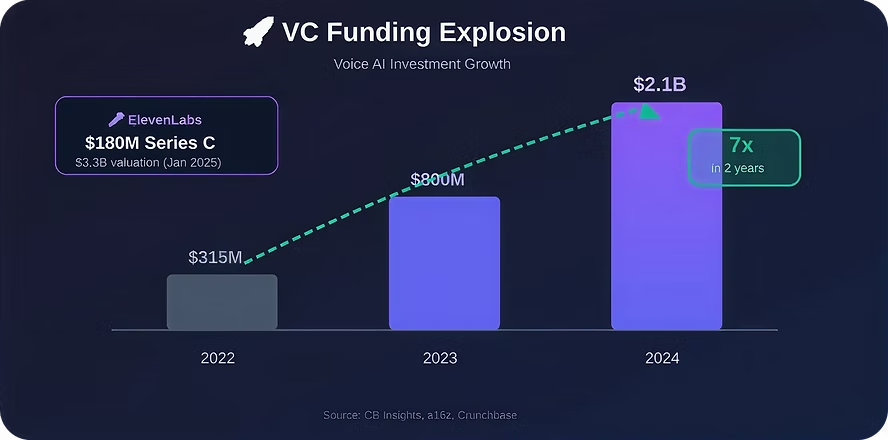
2. VC money went from trickle to tsunami. Voice AI funding exploded from $315 million in 2022 to $2.1 billion in 2024-a 7x increase. ElevenLabs just raised $180 million at a $3.3 billion valuation. When that much smart money moves that fast, pay attention.
3. Real companies started reporting real ROI. Not pilot programs. Not proof-of-concepts. Actual production deployments with auditable numbers. Mercari, Japan’s largest C2C marketplace, is projecting 500% ROI by end of 2025. That’s not a typo.
The $846 Billion Problem Nobody Wants to Talk About
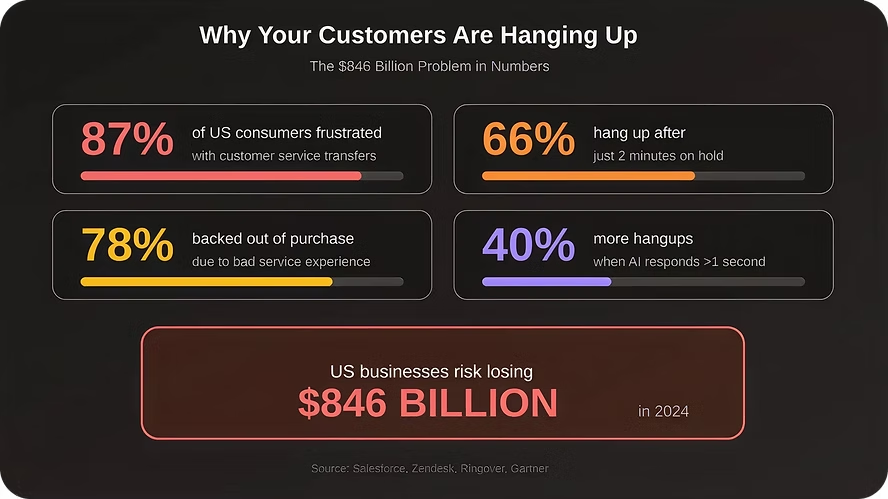
Here’s a statistic that should make every customer service executive lose sleep: 87% of US consumers report frustration with being transferred between agents, according to Salesforce’s 2024 State of Customer Service report. But wait, it gets worse.
66% of customers hang up after waiting just two minutes on hold. 78% have backed out of a purchase because of a poor service experience. The cumulative damage? US businesses risk losing $846 billion in 2024 due to poor customer service.
That hold music you paid a consultant to select? Your customers never hear the good part-they’ve already hung up.
The Math Your CFO Doesn’t Want to See
Let’s talk about what traditional call centers actually cost. A 20-person customer service operation runs approximately $694,000 annually in staffing costs alone. Training a single agent costs around $7,500. And here’s the real kicker: annual turnover in call centers runs between 30-45%.
Do the math. You’re spending roughly $13,745 per agent in replacement costs—recruitment, training, and lost productivity. That’s not a staffing strategy; that’s an expensive revolving door.

AI voice agents? Operating costs as low as $0.09 per minute. No sick days. No turnover. No “I need to put you on hold while I check with my supervisor.”
The 800 Millisecond Revolution
Here’s why latency matters more than any other technical specification: every additional second of response time increases customer hangups by 23% and decreases satisfaction scores by 16%. At 1+ second response times, 40% more customers disconnect.
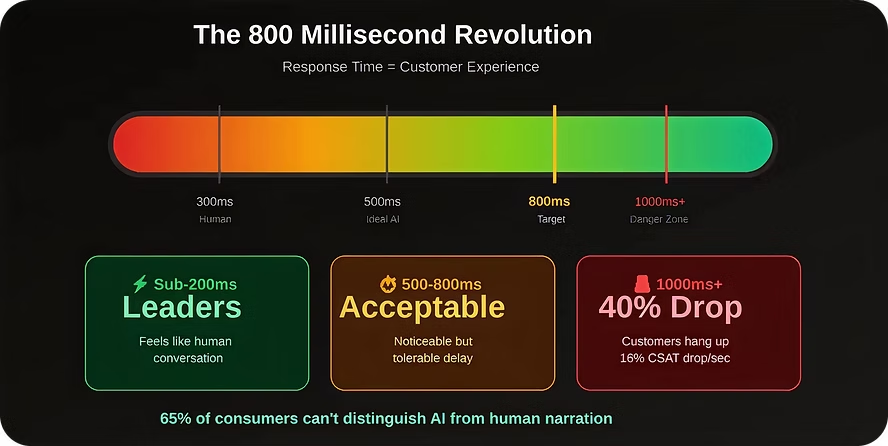
The breakthrough came when providers cracked sub-200ms response times. At that speed, 65% of consumers can’t distinguish AI narration from human speech. We’ve crossed the uncanny valley—and most customers don’t even notice.
The 500% ROI Bombshell: Mercari’s Real-World Story
Mercari operates Japan’s largest C2C marketplace with 20 million monthly active users. They didn’t run a “pilot program.” They deployed Google Cloud’s generative AI agents in production for customer support.

Their AI agents handle inbound queries for lost packages, refund requests, and account issues—routing complex cases to human agents. The result? A projected 500% ROI by end of 2025 and 20% reduction in agent workload. This isn’t a vendor press release. This is verified production deployment data.
The Enterprise Stampede
The adoption numbers tell the story: 80% of call centers now use AI-based technologies. 76% are actively increasing implementation. 52% of executives have already deployed AI agents, with 39% running 10+ agents in production.

The ROI timeline? 74% achieve positive returns within the first year. 56% report business growth directly attributable to generative AI, with 71% of those seeing revenue increases.
India’s Voice Revolution: Where 1.4 Billion Voices Meet AI
Here’s the elephant in the room that most Western-focused analyses miss: 85% of India’s population doesn’t speak English fluently. With 22 official languages, 19,500+ dialects, and 870 million internet users, the country represents the most linguistically complex—and most underserved—voice AI market on the planet.
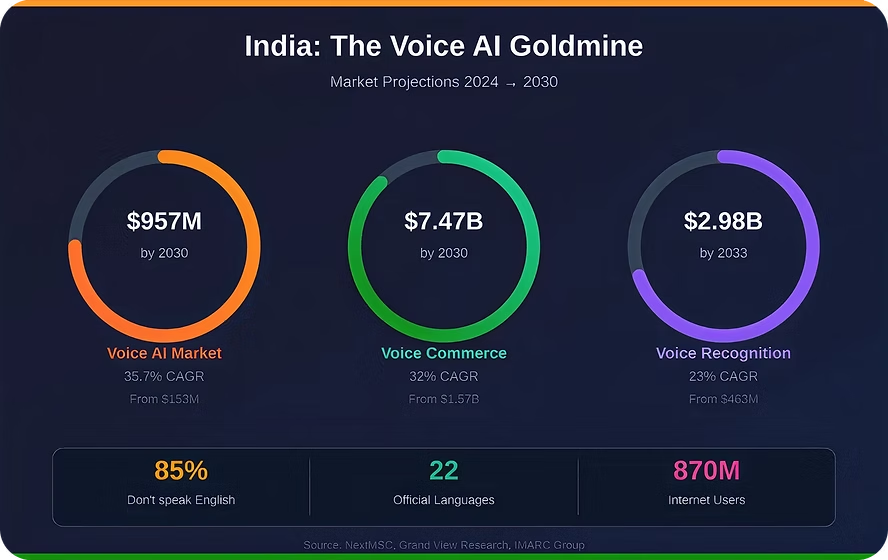
India’s voice AI market is projected to grow from $153 million in 2024 to $957 million by 2030—a 35.7% CAGR. Voice commerce alone will hit $7.47 billion by 2030. These aren’t optimistic projections; they’re mathematical certainties given the smartphone penetration trajectory.
Enter Sarvam AI: India’s Homegrown Champion
Founded in Bengaluru by Vivek Raghavan and Pratyush Kumar, Sarvam AI has emerged as the country’s answer to the multilingual voice challenge. With $41 million in Series A funding led by Lightspeed Ventures and government backing including 4,096 NVIDIA H100 GPUs, they’re not playing catch-up—they’re building India-first infrastructure.

Their Bulbul-V2 TTS model supports 11 Indian languages with authentic regional accents and handles code-mixed text (Hinglish, Tanglish) that breaks most Western models. The kicker? It’s 5x cheaper and 2x faster than ElevenLabs for Indian languages.
Production Deployments That Matter
Meesho automates 60,000+ customer support calls daily in Hindi and English. Cars24 handles 20,000 multilingual conversations monthly with 50% faster issue resolution. Gnani.ai processes 10 million daily interactions for major banks. These aren’t experiments—they’re production systems handling real Indian customers in their preferred languages.
The cost advantage is staggering: multilingual voice AI typically reduces operational costs by 60-70% in India. A business spending ₹50 lakhs monthly on customer support can realistically save ₹30-35 lakhs with automation while improving call resolution rates by 25%.
The Crystal Ball: Where Voice AI Takes Us
Based on current trajectories and verified market data:
| Year | Market Size | What It Means |
| 2024 | $2.4B | Baseline. India at $153M |
| 2030 | $20.4B | AI handles 70%+ routine calls. India hits $1B |
| 2034 | $47.5B | Traditional call centers become legacy |
| 2040 | ~$140B | Voice becomes default customer interface |
| 2050 | $400B+ | 90%+ service interactions via voice AI |
The Bottom Line
Voice AI isn’t coming—it’s here, it works, and early adopters are turning pennies into pirate treasure while their competitors pay consultants to optimize hold music playlists.
The question isn’t whether to implement voice AI. It’s whether you want to be the company that figured it out early, or the one explaining to the board why your customer satisfaction scores look like a limbo competition.
Your customers are waiting. For once, don’t make them wait on hold.
Ready to build your voice AI solution?
Wolvio Intelligence builds production-ready AI voice agents for transportation, healthcare, and enterprise. We’ve shipped systems in English, Tamil, and Tanglish—with real metrics, not PowerPoint promises.
Book a free 30-minute consultation Let’s talk →
Sources:
Market.us, MarketsandMarkets, Grand View Research, McKinsey, Google Cloud, Salesforce, Zendesk, Gartner, CB Insights, a16z, Sarvam AI, ElevenLabs, NextMSC, IMARC Group, Outlook Business, Forbes, Deloitte, HubSpot, PwC
- The End of Screens: AI and the Future of UI - April 21, 2026
- Veeva Vault 26R1 Doctype Triggers Guide - April 7, 2026
- Enterprise AI Adoption Roadmap Guide - March 5, 2026